For older tenants, an elevator in an apartment building is often not a luxury, but a necessity. In Herpersdorf-a district of Nuremberg with a housing stock built between the 1960s and 1980s-many owners are faced with the question of whether retrofitting is worthwhile. KfW funding, demographic change, and rising demand for barrier-free housing all strongly support this in 2026.
Demographic Change as a Driver: Why Elevators Will Gain Importance in 2026
Germany is aging faster than many other industrialized nations. In the Nuremberg metropolitan region, the proportion of people over 65 will rise to around 25% by 2035-one in four residents will then be of retirement age. This age group has significantly increased mobility needs within residential buildings: stairs become a problem when knees and hips no longer cooperate.
At the same time, the proportion of apartment buildings without elevators is growing in Nuremberg: A good 60% of the housing stock built between 1950 and 1990 has no elevator. This creates a clear gap in demand that landlords can fill by investing in retrofitting-and in doing so, unlock potential for rent increases.
The ICE plant in Herpersdorf employs a workforce with a broad age range: from young trainees to experienced skilled workers over 55. The latter are increasingly willing to pay more for barrier-free apartments-especially in residential areas near their workplace.
Legal Framework: Accessibility in Existing Buildings
There is no general legal obligation to retrofit elevators in Bavaria. The BayBO (Bavarian Building Code) only mandates elevators in new buildings with five or more stories (Art. 37 BayBO). Existing buildings are grandfathered in-except in cases of major renovations or changes in use that trigger a full re-evaluation.
However, several factors are creating pressure to act: KfW funding makes retrofitting more economically attractive than ever. Demographic trends in the Nuremberg metropolitan region-the proportion of people over 65 is set to rise to approximately 22% by 2030-are increasing the demand for accessible housing. And landlords managing condominium units are increasingly seeing majority votes in favor of retrofitting elevators under Section 20 of the WEG (structural alterations at the request of an owner if reasonable).
Section 20 of the WEG (Condominium Act) has been the central provision since the 2020 WEG reform: A single condominium owner may demand the installation of an elevator if they bear the costs and the measure is technically feasible. The community cannot permanently refuse this if the structural intervention is reasonable.
Costs and Economic Viability 2026
| Elevator Type | Building Type | Investment Costs (€) | KfW Loan Available | Payback Period (Years) |
|---|
| Interior elevator (stairwell) | 4-unit apartment building, 3 stories | 45,000-75,000 | Yes (KfW 159) | 15-25 |
| Exterior shaft elevator (addition) | 6-unit apartment building, 4 stories | 60,000-100,000 | Yes (KfW 159) | 18-28 |
| Platform lift (limited accessibility) | 4-unit apartment building, 3 stories | 15,000-30,000 | Yes (KfW 159) | 10-16 |
| Compact elevator (residential building) | Single-family home/duplex, 2-3 stories | 20,000-35,000 | Yes (KfW 159) | 12-20 |
| Elevator with solid shaft construction | Multi-family building with 8 units, 5 stories | 90,000-150,000 | Yes (KfW 159) | 20-30 |
Source: KfW Program 159 Age-Appropriate Renovation, terms Q2 2026; KfW Program 455-B Investment Grant for Accessibility; DIN 18040-2 Accessible Construction; Cost Survey by the Central Association of the German Construction Industry Q1 2026.
The payback period is calculated based on the rent increase resulting from the elevator plus the avoidance of vacancies in upper-floor apartments, not solely on the direct revenue from the elevator. For a four-unit building with two upper-floor apartments, each of which sees a rent increase of 50 euros/month due to the elevator, this amounts to 1,200 euros/year - the payback period for a €60,000 elevator after KfW funding (owner’s contribution approx. €30,000) is then approx. 25 years, without any additional appreciation effects.
Typical elevator models for existing buildings: Which one is right?
For post-war apartment buildings in Herpersdorf, three elevator types are typically considered:
Machine-room-less rope elevator (MRL): The most modern standard. The drive is located at the top of the shaft instead of in a separate machine room. Suitable for new shafts with sufficient ceiling height. Energy consumption approx. 1-2 kWh per day under normal operation. Low maintenance costs due to standardized technology.
Hydraulic elevator: Inexpensive to purchase (10-20% less than a rope elevator), but higher energy consumption and hydraulics that are more sensitive to temperature fluctuations. Suitable for buildings with a shallow shaft and low height (up to 3-4 stories). In Herpersdorf, a cost-effective option for simple 3-story buildings.
Platform lift: Not a full-fledged elevator, but a cost-effective solution for limited accessibility (not fully compliant with DIN 18040-2). Suitable for buildings where a full elevator shaft is not structurally feasible. Costs approx. 15,000-30,000 euros - less than half the price of a real elevator. Eligible for KfW 159 and 455-B funding, but not recognized as a comprehensive accessibility solution.
Practice: Planning and Approval in Herpersdorf/Nuremberg
Retrofitting an elevator is a construction project that requires careful preliminary planning.
Preliminary Structural Assessment: First, an architect or specialist planner must determine whether and how an elevator can be installed. Three basic options exist: an interior elevator in the stairwell (reducing stairwell space), an elevator in the light well (if available), or an exterior elevator as an addition. In Herpersdorf’s post-war buildings, exterior elevators are often the structurally simpler solution, as the stairwells are narrow.
BIM Planning: Building Information Modeling (BIM) is increasingly being used in larger elevator retrofit projects. BIM-capable design firms in Nuremberg enable precise clash detection-particularly relevant for external elevators, which cannot be easily positioned in densely built-up neighborhoods. In Herpersdorf, where many apartment buildings are constructed in a closed layout, this precision is crucial.
Building Permit: A building permit application must be submitted to the Nürnberger Land District Office or the City of Nuremberg Building Authority (for the Herpersdorf area). Elevator systems are subject to the Elevator Ordinance (BetrSichV) and must be inspected and approved by a certified expert (DEKRA, TÜV).
> With the valuation tool from leadmarkt.ch, you can estimate how an elevator will affect the income value of your multi-family home in Herpersdorf-free of charge and data-driven.
KfW Application: KfW 159 loans and KfW 455-B grants must be applied for before construction begins. The grant amounts to up to 6,250 euros per residential unit, with a maximum eligible amount of 50,000 euros per residential unit.
Local Context: Herpersdorf and the ICE Maintenance Facility Workforce
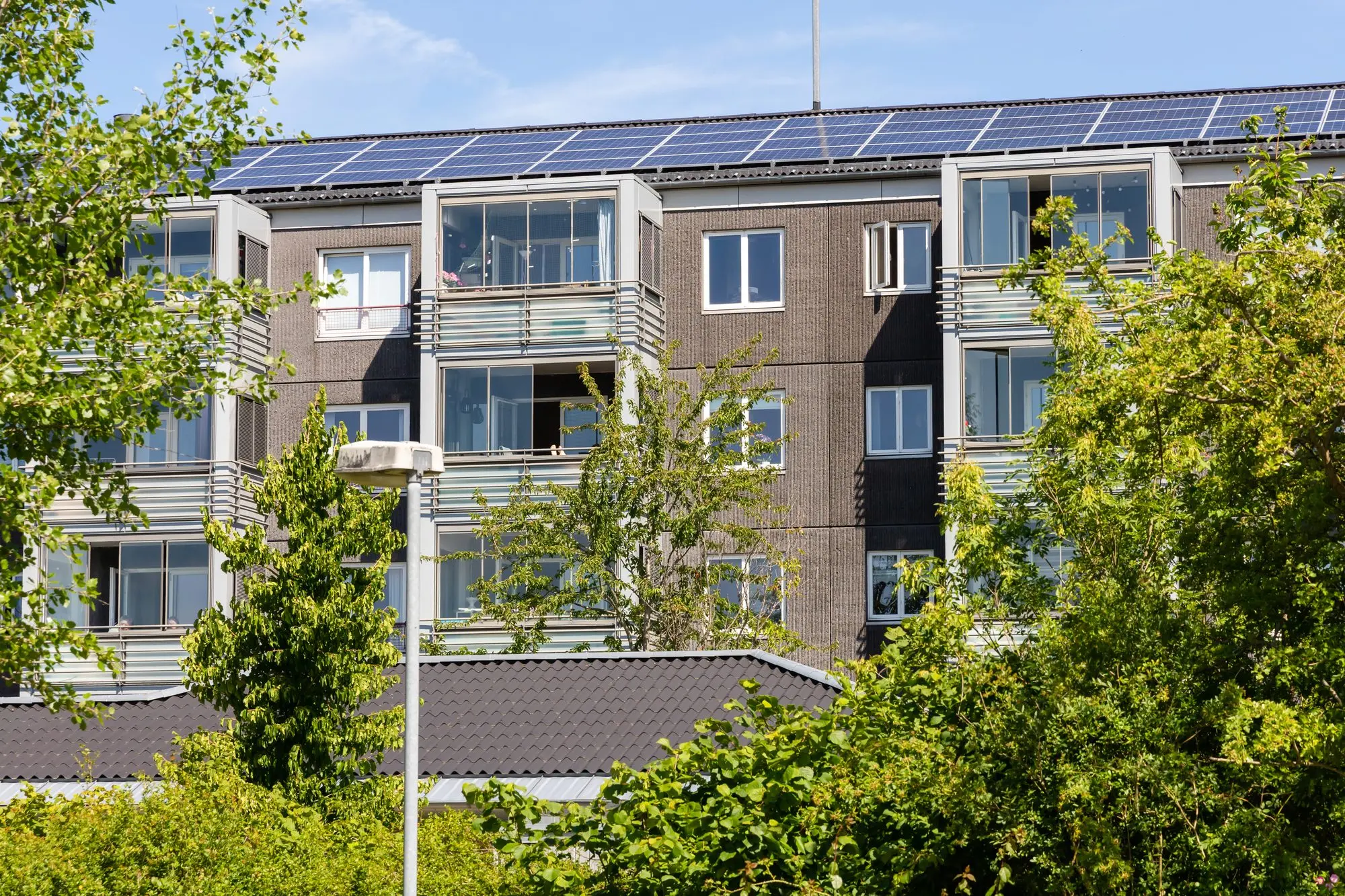
Nuremberg-Herpersdorf is characterized by its proximity to Deutsche Bahn’s ICE maintenance facility in northwest Nuremberg. The resident population is diverse: younger families, young professionals, and older adults who have lived in the same buildings since the 1960s.
This age structure makes elevator retrofits particularly relevant: Older tenants in upper-floor apartments without elevators have limited mobility. The risk of vacancies in these apartments is rising. A retrofittable elevator is an incentive for existing tenants to stay in the building and for new tenants in the 60+ age group who prioritize accessibility.
In Herpersdorf, there are several apartment buildings from the 1960s-1970s that are structurally well-suited for exterior elevators-wide covered walkways and freestanding gable walls provide space for shaft constructions. A feasibility study costs 800-2,500 euros and is a sensible first investment before making a concrete decision.
WEG Resolution: How Voting Works in Homeowners’ Associations
In homeowners’ associations (WEG), retrofitting an elevator constitutes a structural modification under Section 20 WEG. Since the 2020 WEG reform, the following applies:
An individual owner may request the installation of an elevator at their own expense. The association is expected to reasonably tolerate this, provided it does not result in unreasonable disruptions. If approved by a simple majority, the association bears the costs; if rejected by a majority, the applicant may carry out the work at their own expense.
Property managers and advisory board members in Herpersdorf WEG communities report that elevator applications have increased since 2022 and that willingness to provide community funding is growing.
Maintenance and Operation: Running Costs of an Elevator
After commissioning, running costs arise that must be included in the cost-benefit analysis. The Operating Safety Ordinance (BetrSichV) requires regular inspections by a certified expert (ZÜS, e.g., DEKRA, TÜV): a major inspection every 2 years, and an interim inspection every 2 years between major inspections (i.e., alternating annually). Costs: 150-350 euros per inspection.
Maintenance contract with the elevator manufacturer or an independent elevator maintenance company: approx. 800-2,000 euros per year for a basic residential building model. The maintenance contract includes emergency service (24/7 availability in case of entrapment) - mandatory under BetrSichV.
These operating costs can be passed on to tenants via the operating cost statement (Section 2 of the Operating Cost Regulation, No. 7: Elevator Costs). In return, the elevator justifies the aforementioned rent increase for new leases. For residential buildings in Nuremberg-Herpersdorf, landlords charge an average of 15-30 euros per residential unit per month for elevator operation in the operating cost statement.
Conclusion for Landlords in Herpersdorf
By 2026, an elevator will be a financially sound investment for many multi-family home owners in Herpersdorf: KfW subsidies reduce the out-of-pocket cost, demographic change increases demand, and rent increases and vacancy prevention generate real returns. Planning should begin early-permits and KfW applications take time. Those offering barrier-free apartments in the Herpersdorf area near the ICE plant will meet a demand that will continue to grow in the coming years.
Before calculating an elevator investment, we recommend a current income-based valuation for your property: The valuation tool from leadmarkt.ch takes accessibility and amenities into account and provides a realistic market valuation.
Elevator Types for Multi-Family Home Retrofits: Which Option Is Right?
Not every elevator is suitable for every existing building. For multi-family home owners in Herpersdorf, these types are relevant:
Hydraulic elevator: Space-saving, no separate machine room required. Suitable for buildings up to 4 stories. Slower than cable-driven elevators (0.6 m/s), but perfectly adequate for residential buildings. Higher energy consumption than cable-driven elevators due to hydraulic oil heating. Cost: €35,000-55,000 in new construction, €50,000-75,000 for retrofitting.
Machine-room-less rope elevator (MRL): Modern standard, no machine room required (motor in the shaft). More energy-efficient than hydraulic elevators. Ideal for 4-6 stories. Cost: €40,000-€65,000 for new construction, €55,000-€85,000 for retrofitting.
Platform lift / stairlift: More cost-effective (€15,000-30,000), but not a full-fledged passenger elevator. Conceivable for Herpersdorf as a temporary solution in small buildings. Lower insurance requirements.
| Type | Retrofitting Cost | Floors | Speed | Eligible for Funding |
|---|
| Hydraulic elevator | €50,000-75,000 | up to 4 | 0.6 m/s | KfW 455-B |
| MRL cable elevator | €55,000-85,000 | up to 6 | 1.0 m/s | KfW 455-B |
| Platform lift | €15,000-30,000 | up to 3 | 0.15 m/s | conditional |
Building Regulations and Permits in Nuremberg-Herpersdorf
Retrofitting an elevator requires a building permit. The Nuremberg Building Authority processes applications for elevator retrofits in multi-family residential buildings within the city limits, which include Herpersdorf as part of Nuremberg’s northwest district.
Building Permit Application: Plans (floor plan, cross-section, elevation), structural analysis for the shaft, proof of compliance with clearance distances and fire safety requirements. Processing time at the Nuremberg Building Authority: 8-16 weeks.
Inspection by ZÜS: Upon completion, an inspection expert (ZÜS) inspects the system and issues a certificate of commissioning. The elevator may only be operated after this certificate has been issued. In Nuremberg, DEKRA, TÜV Rheinland, and GTÜ are approved as ZÜS.
Important: The KfW-455-B subsidy must be applied for before commissioning the elevator company-not after acceptance. Otherwise, the subsidy will not be granted.
Compiled by the my-home.de editorial team in collaboration with regional real estate analysts. Data as of Q2 2026.