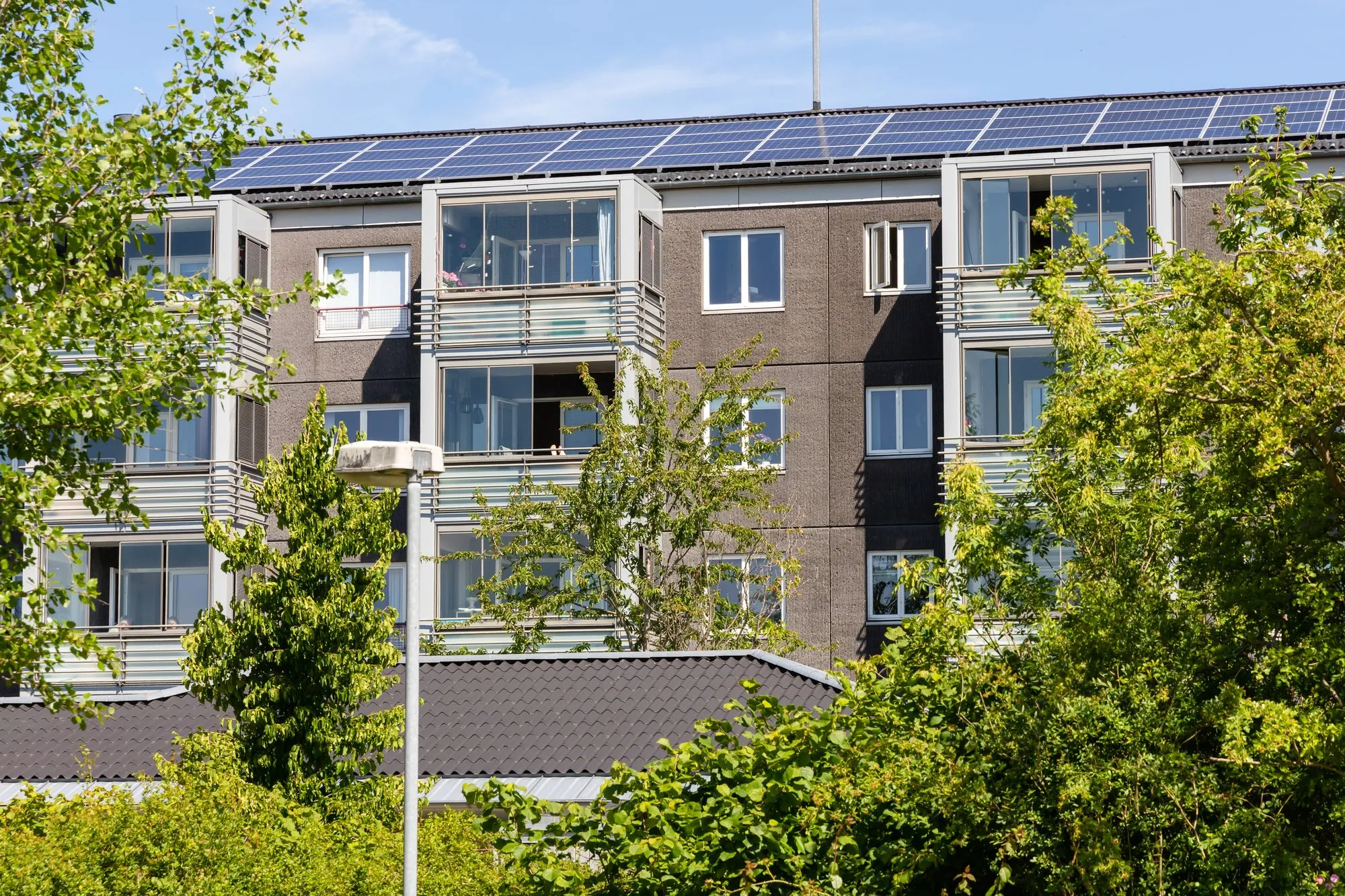
Supplying solar power directly from the roof to the residents of your own apartment building-the tenant-power model makes exactly that possible. In Nuremberg-Herpersdorf, where Deutsche Bahn’s ICE maintenance facility attracts many tenants with stable incomes to the residential areas, the concept is gaining increasing interest. Since the 2023 EEG reform, the legal framework has improved. In 2026, it’s worth taking a closer look at the numbers and real-world implementation.
Why tenant-generated electricity is more relevant than ever in 2026
The framework conditions for tenant-generated electricity have improved significantly since 2022. Rising electricity prices increase the cost savings for tenants; lower PV system prices (down 40% since 2021) improve profitability for landlords; and the 2023 EEG reform has expanded the tenant-generated electricity surcharge to include new building types. Together, these three factors make tenant-generated electricity one of the most attractive rental concepts of 2026-especially in densely populated neighborhoods like Nuremberg-Herpersdorf, where there are many apartment buildings with large, well-exposed roof areas.
The German Solar Industry Association (BSW-Solar) reports a 34% increase in newly registered tenant-generated electricity projects for the first quarter of 2026 compared to the same period last year-a clear signal that the market is mature.
Basic Principle and Legal Framework of Tenant Electricity
With tenant electricity, the self-generated PV electricity does not leave the building: It is sold directly to households in the same building via internal wiring-the building’s internal electrical system. This distinguishes tenant electricity from conventional PV operation with grid feed-in.
The legal framework is derived from the Renewable Energy Sources Act (EEG 2023, Section 21 Tenant Electricity Surcharge), the Energy Industry Act (EnWG), and the Low-Voltage Connection Ordinance (NAV). The landlord acts as a so-called “tenant electricity provider”-a micro-supplier who is, however, required to register with the Federal Network Agency.
Since the 2023 EEG reform, the following applies: The tenant electricity surcharge is granted not only for residential buildings but also for commercial buildings and mixed-use buildings, provided the residential portion predominates. This expands the potential, particularly for existing buildings with ground-floor commercial space.
Important: The tenant electricity surcharge under Section 21 EEG is in addition to the market price advantage. It is paid for every kWh that is actually supplied to tenants-not fed into the grid.
Revenue Scenarios 2026: What Pays Off
| System Size (kWp) | Annual Yield (kWh) | Self-Consumption Rate | Tenant Electricity Revenue (€/year) | Tenant Electricity Surcharge (€/year) | Total Revenue (€/year) |
|---|
| 15 kWp (6 units) | 13,500 | 65% | 1,080-1,755 | 200-360 | 1,280-2,115 |
| 30 kWp (12 units) | 27,000 | 70% | 2,268-3,780 | 380-756 | 2,648-4,536 |
| 50 kWp (20 modules) | 45,000 | 75% | 4,050-6,750 | 590-1,124 | 4,640-7,874 |
| 100 kWp (40 units) | 90,000 | 75% | 8,100-13,500 | 1,120-2,250 | 9,220-15,750 |
Source: Federal Network Agency Tenant Electricity Register Q2 2026; EEG 2023 § 21 Tenant Electricity Surcharge Scale; Solar Yield Simulation for the Nuremberg Metropolitan Region (approx. 950 kWh/kWp/year), as of Q1/Q2 2026.
Note on revenues: The margin of 2-5 cents/kWh arises because landlords are permitted to offer tenant electricity at the fixed tenant electricity rate (max. 90% of the local basic supply price according to the EEG), while the production costs are significantly lower. With a basic supply price in Nuremberg of approx. 28-32 cents/kWh, the tenant electricity rate is max. 25-29 cents/kWh; the production costs (PV system annuity + operation) are 8-14 cents/kWh.
Practice: Steps for Implementing a Tenant Electricity Project
Implementing a tenant electricity model follows a clearly structured process. Property owners in Herpersdorf who own a multi-family building with at least 4 residential units can take the following concrete steps.
Building Screening: Check the roof orientation and area, structural suitability, shading from surrounding buildings, and the current meter inventory. In Herpersdorf, there are many post-war buildings from the 1960s whose flat roofs are well-suited for PV but often require renovation. A roof renovation prior to PV installation makes economic sense.
Preliminary Grid Inquiry: Submit a preliminary inquiry to the responsible grid operator (N-ERGIE AG for Nuremberg-Herpersdorf) regarding grid connection and the meter concept. A total meter concept is required for tenant electricity: A main meter records the total PV feed-in, while one sub-meter per residential unit measures tenant electricity consumption.
Tenant Communication: Inform the tenants early on. Signing tenant electricity contracts is voluntary; experience shows that 60-80% of tenants accept the offer if the price advantage is clearly communicated.
> With the valuation tool from leadmarkt.ch, you can check in advance how a tenant electricity upgrade affects the income value of your apartment building in Herpersdorf-data-driven, in just a few minutes.
Federal Network Agency Registration: Register the PV system and yourself as a tenant electricity provider in the Federal Network Agency’s market master data registry. You are only entitled to the tenant electricity surcharge after registration. Registration is available online at no cost.
Annual Billing Requirement: As a tenant electricity provider, you are required to provide annual billing to your tenants (Section 17 EnWG). Specialized tenant electricity software (e.g., from providers such as Buzzn, StromDAO, Enpal) handles billing, tax reporting, and grid fee settlement.
Local Context: Herpersdorf and the ICE Maintenance Facility Area
Nuremberg-Herpersdorf is a northwestern district of Nuremberg, characterized by Deutsche Bahn’s ICE maintenance facility-one of Germany’s largest railway technology hubs. The facility employs several thousand workers, many of whom live in the adjacent residential areas of Herpersdorf, Schweinau, and Muggenhof.
For landlords, this tenant structure means stable tenancies, an above-average willingness to pay for energy services, and an interest in long-term price guarantees. Tenant-generated electricity models with fixed rates over 5-10 years are well-received by this group of tenants.
Most of the residential buildings in Herpersdorf date from the 1950s to the 1970s. Many have flat or gabled roofs facing south and offer sufficient space for 15-50 kWp systems. The average apartment size is 60-75 m², resulting in an annual consumption of 2,000-3,000 kWh per household-a good fit for typical multi-family residential PV system sizes.
Tax Aspects of Tenant-Generated Electricity
Landlords who supply tenant-generated electricity are classified as commercial entities in the energy sector for tax purposes. This has several consequences:
The PV system and its operation are subject to sales tax. Since the VAT exemption for PV systems up to 30 kWp on residential buildings (Section 12(3) of the German VAT Act, effective 2023), a 0% VAT rate may apply to small systems-but not to the sale of electricity itself, which remains subject to 19% VAT.
Revenue from tenant electricity is subject to income tax. The following are deductible: depreciation of the PV system (AfA), operating costs, and administrative expenses. For commercial PV use (over 10 kW capacity), trade tax may apply-the trade tax exemption threshold is 24,500 euros in profit, which is rarely exceeded in tenant-generated electricity operations.
Important for your tax return: Tenant electricity revenue must not be combined with rental income. It must be recorded in a separate cash basis accounting statement (EÜR). A tax advisor with experience in energy tax law-there are consulting firms specializing in energy issues in Nuremberg and Erlangen-is recommended when implementing a tenant electricity model.
Technical Requirements: Smart Meters and Total Metering Concept
For PV systems with a capacity of 7 kW or more, the Metering Point Operation Act (MsbG) mandates the installation of smart metering systems (iMSys/smart meters). For tenant-generated electricity systems, the total metering concept is the technical standard: A main meter records the building’s total electricity consumption from the grid; a generation meter measures the PV yield; and individual household meters record the consumption of each rental unit.
The grid operator (N-ERGIE AG in Nuremberg-Herpersdorf) must approve the metering concept in advance. For complex multi-family housing projects with more than 10 residential units, involving a competitive metering point operator (wMSB) can offer more flexible solutions than the primary grid operator. Experience shows that the lead time for grid approval and smart meter installation is 3-6 months-this time must be factored into project planning.
Tenant Electricity Contract: What It Should Include
A legally sound tenant electricity contract contains the following key points: supply volume and price (fixed or variable rate, maximum 90% of the local basic supply price), term and notice periods (recommended: 12-month notice period), procedures in case of underdelivery (which supplier automatically takes over the basic supply contract?), data protection (meter reading transmission), annual billing (required under Section 17 of the Energy Industry Act). Specialized tenant electricity service providers offer sample contracts; individual legal advice from an attorney specializing in energy law is recommended before signing.
The Bavarian Consumer Advice Center regularly warns against unscrupulous tenant electricity providers who pressure landlords into long-term exclusive contracts. Scrutinize service providers carefully-reputable providers have reference projects, are listed in the market master data registry, and provide transparent terms and conditions.
Conclusion for Landlords in Nuremberg-Herpersdorf
Tenant electricity models for apartment buildings will be technically mature, legally well-regulated, and economically viable by 2026. The tenant electricity surcharge under the EEG 2023, rising electricity prices, and the tenant base in the ICE-Werk area make Herpersdorf a good location for such projects. Key tasks: Submit a preliminary grid inquiry to N-ERGIE, ensure registration with the Federal Network Agency, and inform tenants early on.
Before you invest, it’s worth obtaining a current income-based valuation for your property: The valuation tool from leadmarkt.ch takes energy-efficiency upgrades into account and provides a realistic market valuation for your multi-family home in Herpersdorf.
Technical Requirements: PV System and Metering Infrastructure
For a tenant-power model in Herpersdorf, the following minimum technical requirements must be met:
Roof-mounted PV system: The system must be large enough to cover a significant portion of the tenants’ household electricity needs. Rule of thumb: 1 kWp of PV per tenant-power residential unit. For 6 residential units, this means at least 6 kWp-preferably 8-10 kWp to include common areas (stairwell lighting, basement, washing machines).
Smart meter gateway: Each residential unit requires a modern metering system (smart meter) with a communication connection. The installation of smart meter gateways is regulated by law (Metering Point Operation Act, MsbG). The primary metering point operator (usually N-ERGIE for Herpersdorf) installs the devices; installation dates require coordination.
Metering Concept with Total Meter: The total meter measures the total feed-in from the PV system into the building grid. Together with the individual meters for the residential units, the proportion of tenant electricity for each unit can be calculated precisely. The metering concept must be approved by N-ERGIE.
| Component | Cost | Responsible Party |
|---|
| PV system (8 kWp) | €12,000-16,000 | Owner |
| Smart meter per unit (6 units) | €600-1,200 | N-ERGIE (installation), Owner (device) |
| Total meter + feed-in measurement | €500-800 | N-ERGIE |
| Energy management software | €1,000-3,000 (one-time) | Owner (service provider) |
Communication with Tenants: The Key to Project Success
Tenant electricity projects often fail not because of the technology, but because of tenant communication. Tenants in Nuremberg-Herpersdorf-many of whom work shifts at the ICE plant-appreciate clear, simple information. Recommendation:
- Information evening (optional): Brief presentation of the concept, answering questions, making the cost-benefit analysis transparent
- Simple information sheet with three key points: What does it cost? How much will I save? What will change for me?
- Allow opt-out: Every tenant who wishes to remain with their default provider has this right. An open offer without pressure leads to higher acceptance
Experience from other multi-unit housing projects in Herpersdorf (as of Q1 2026): If the tenant-generated electricity offer is 25-30% below the basic utility rate, typically 70-85% of tenants opt for the tenant-generated electricity model-enough to ensure an economically viable system.
Compiled by the my-home.de editorial team in collaboration with regional real estate analysts. Data as of Q2 2026.