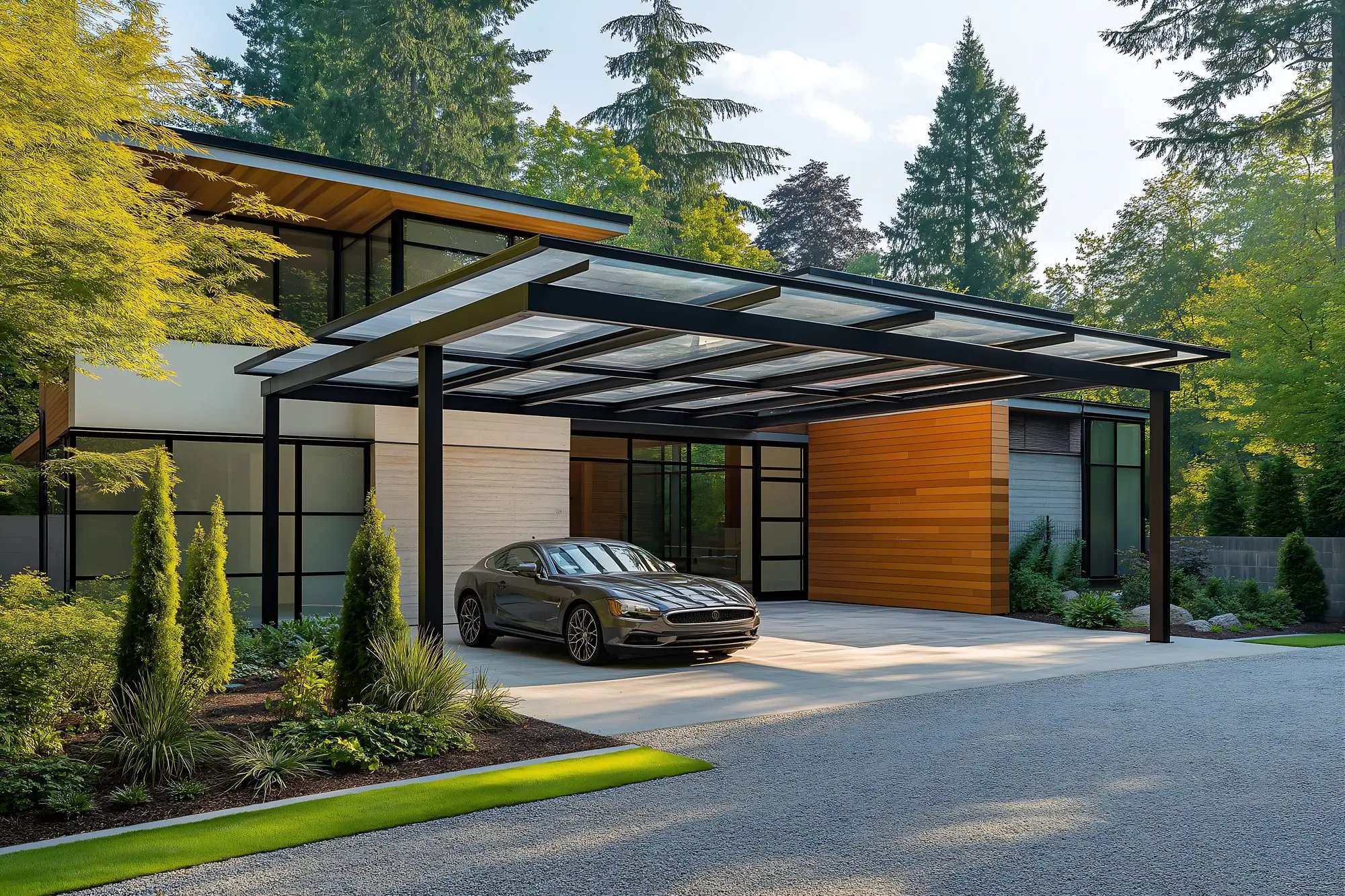
Anyone in Lauf an der Pegnitz who wants to expand their home-whether through an addition, a sunroom, a carport, or an extra room-needs to understand when the Bavarian Building Code requires a formal building permit application and when construction is permitted without involving the building authority. The boundaries are clearer than one might think, but the exceptions and pitfalls are numerous.
Exemption from the Building Permit Process under BayBO Art. 57: What Applies to Additions
Art. 57 of the Bavarian Building Code lists all projects that may be constructed without a building permit process. The following provisions are relevant for additions to residential buildings:
Art. 57(1)(1) BayBO (Outbuildings and Additions): Additions within the inner city area (§ 34 BauGB) or in development zones (§ 30 BauGB) with a gross floor area of up to 75 m³ are exempt from the permitting process. A single-story addition with a floor area of 25 m² and 3 m wall height + flat roof has a gross floor area of approx. 75 m³ - right at the limit.
Art. 57(1)(9) BayBO (Glazing, Conservatories): Canopies and glazing with a floor area of up to 30 m² may be exempt from the permitting process if they do not result in a change of use.
Important: Residential use in an addition changes the permit requirement. Anyone constructing an addition for residential purposes (bedroom, bathroom, living room) is always subject to a permitting process if this results in a change of use under building law or if the addition exceeds the limits of Art. 57.
Exemption from the permit process does not exempt the project from compliance with substantive building regulations. Specifically for Lauf, this means: Even without a permit, the addition must comply with setback requirements, zoning plan stipulations, and fire safety requirements.
Market Data 2026: Costs and Added Value of Additions in Lauf
| Addition Type | Living Area | Gross Floor Area (approx.) | Total Cost | Value Added | Requires Permit? |
|---|
| Conservatory (unheated) | 15-25 m² | 35-60 m³ | €15,000-40,000 | €12,000-30,000 | Possibly no (< 75 m³) |
| Single-story residential addition | 20-30 m² | 55-80 m³ | €40,000-80,000 | €35,000-65,000 | From 75 m³: Yes |
| Roof terrace conversion | 20-35 m² | - | €25,000-€55,000 | €20,000-€45,000 | Usually yes |
| Garage/carport addition | 18-50 m² | 35-125 m³ | €10,000-30,000 | €8,000-20,000 | Up to 50 m², 3 m ceiling height: No |
| Basement expansion | 15-30 m² | - | €30,000-€60,000 | €15,000-€35,000 | Usually yes |
Source: Nuremberg Region Appraisal Committee, 2025 Annual Report; Cost Guidelines of the Bavarian Chamber of Architects 2025/2026; IVD Middle Franconia Market Report 2025.
In Lauf an der Pegnitz, single-family homes with an addition or expanded living space command, on average, 8 to 15 percent higher prices per square meter than comparable properties without an addition, provided the addition is of high quality and fully compliant with building codes. Unauthorized extensions, on the other hand, are a significant obstacle to a sale: buyer’s banks and notaries verify that the existing structure matches the approved plans; any discrepancies must be rectified or legalized.
Practice: The Building Permit Process in Lauf, Step by Step
If an addition exceeds the limits of the exemption from formal procedures, a formal building permit application must be submitted to the Nürnberger Land District Office (as the lower-level building authority for the area surrounding Lauf) or the Lauf City Building Authority.
Step 1: Preliminary Inquiry. Before submitting the formal application, it is advisable to make an informal preliminary inquiry with the building authority. In about half an hour, you can clarify whether the project is generally eligible for approval, which zoning plan provisions apply, and what documents are required.
Step 2: Planning by a licensed architect. For projects requiring approval, a licensed architect or civil engineer must prepare the submission plans. Fees typically range from 4,000 to 12,000 euros, depending on the scope of services.
Step 3: Submit the building application. In Bavaria, the building application can be submitted digitally via the BayernPortal online portal. The documents include: site plan (to scale), floor plans, sections, elevations, structural calculations (for new structural systems), and calculations of setback distances.
Step 4: Processing time. In practice, the processing time at the Nürnberger Land District Office is 8 to 14 weeks for simple residential construction projects. More complex projects (deviations from the zoning plan, neighbor participation) may take longer.
Step 5: Building Permit and Construction. The building permit is valid for 4 years and expires if construction does not begin within that time. Upon completion, a final inspection by the building authority is required to verify compliance with the permit.
Energy Efficiency Requirements for Additions. For additions requiring a permit that are intended to be heated, the requirements of the Building Energy Act (GEG) apply. The addition must be considered part of the overall building and must comply with the U-value (heat transfer coefficient) requirements for walls, roofs, and floors. For larger extension projects (over 50 m² of usable floor area), proof of energy efficiency must be provided by an energy consultant or architect. The Building Modernization Act (GModG), effective November 2026, further tightens these requirements: Anyone renovating more than 25 percent of the building envelope in a construction phase must bring the overall standard to at least energy class D.
Neighbor Participation. In building permit proceedings where a neighbor may be affected by the project (e.g., because setback distances extend to their property line), the BayBO requires formal neighbor participation. The neighbor is granted access to the plans and may raise objections. In practice in Lauf, it is advisable to informally approach the neighbor before the formal submission and, if necessary, request written consent. This significantly speeds up the process.
> The valuation tool from leadmarkt.ch estimates the current market value of your property in Lauf-with or without potential for expansion-based on data in just a few minutes.
Local Nuance: Lauf and Expansion Opportunities Along the Pegnitz
Lauf an der Pegnitz has a typical mid-sized town structure: a historic old town on the banks of the Pegnitz, surrounded by established residential neighborhoods dating from the post-war period through the 1990s, complemented by newer residential areas on the outskirts. The buildings in the post-war developments are generally well-maintained and sit on lots where extensions are possible and economically viable.
Its proximity to Franconian Switzerland makes Lauf a preferred place to live for families who need space. Additions to create extra children’s rooms, home office spaces, or in-home apartments for the parents’ generation are among the most common planning projects.
Particular attention must be paid to the issue of floodplains, especially in the residential areas near the Pegnitz River: portions of the land along the Pegnitz are classified as HQ100 floodplains on the Bavarian Flood Hazard Map (BayHOK). In such zones, special requirements apply to the construction of additions (flood-proof design, approval from the Water Management Office if necessary).
Homeowners in Lauf planning an addition to create a granny flat should also keep the tax implications in mind: Rented granny flats allow for a proportional deduction of construction costs as depreciation (AfA, 2% per year for residential buildings). With construction costs of 80,000 euros for the addition, this results in 1,600 euros in depreciation per year, which reduces the taxable profit from the rental. Additionally, ongoing repair and maintenance costs can be deducted as business expenses. This basic tax structure makes the in-home apartment an attractive rental model for many owners in Lauf.
To ensure the extension complies with GEG standards, it is advisable to include the BAFA grant application in the architectural planning phase: Those who plan the addition to meet energy-efficient house standards can receive funding for insulation, windows, and heating technology through the KfW Program 297/298 (Climate-Friendly New Construction in Existing Buildings) or via the BEG individual measures. The combination of the building permit requirement and the funding strategy necessitates early coordination with the architect and, if necessary, an energy consultant.
Conclusion for Homeowners in Lauf
The 75-cubic-meter limit is the most important benchmark: below this threshold, an addition in Lauf is generally exempt from the permit process-but not from regulations. Anyone who exceeds this limit or creates new living space needs to submit a building permit application. Investing in an architect for the submission planning is not only mandatory but also makes economic sense, as extensions approved with errors or built without approval significantly complicate the sales process.
Before you start an extension project, it’s worth checking the current market value of your property: The valuation tool from leadmarkt.ch shows you the realistic added value a high-quality extension in Lauf an der Pegnitz can create-based on data and with no consultation fee.
Retroactive Legalization: What to Do About an Unauthorized Addition?
In Lauf and the Nürnberger Land district, there are a number of additions that were built in the 1970s and 1980s without a building permit. Owners of such buildings face the question of whether and how legalization is possible.
The first step is to check whether the addition falls under the current exemptions from the BayBO. If the addition meets today’s criteria for exemption (volume under 75 m³, no new living space, setback distances observed), it is effectively exempt from approval today-but whether it was legal at the time is another question.
Things get complicated when selling the property: Buyers demand statements regarding the building code compliance of all structural components. An architect can conduct a legality review and confirm whether the addition would be exempt from the permitting process today. While this is not a building permit, it serves as a transparent basis for the sales process.
For additions that constitute genuine violations of current building regulations (e.g., insufficient distance from the property line), the option of an exemption under Art. 63 BayBO remains-which the Nürnberger Land District Office may grant at its discretion. This exemption incurs a fee, but it is significantly less than the cost of a legal dispute over a purchase contract for an unlegalized building. Owners who plan to sell their home in the foreseeable future should clarify the building code status of all additions early on.
GEG Requirements for Additions: What Applies in 2026
Since the Building Energy Act (GEG) 2020 and the ongoing tightening of regulations, the following applies: Anyone constructing an addition must comply with the GEG’s minimum energy requirements. This applies to the thermal insulation of exterior components (U-values for walls, roof, floor, windows) as well as the heating system.
For extensions with less than 50 m² of usable floor area, simplified requirements apply (Section 31(1) GEG): Only the exterior components of the extension itself must be GEG-compliant; the rest of the existing building does not need to be retrofitted. For extensions over 50 m², the full GEG requirements apply.
Particularly relevant for Lauf an der Pegnitz: If the existing building has an old gas heating system and the addition is to be heated with a new heat pump, the issue of heating integration must be clarified from both a technical and a funding perspective. The KfW programs for energy-efficient renovation (BEG individual measures) can also be used for the addition if it is implemented together with other renovation measures on the existing building.
Energy consultants (BfEE/dena list) can assist with GEG-compliant planning as well as submit funding applications. Their fees are partially eligible for funding through the BAFA consultant program.
Prepared by the my-home.de editorial team in collaboration with regional real estate analysts. Data as of: May/June 2026.